

Irrigation Programs
Living in a semi-arid climate means that irrigation is essential for crops to meet their water requirements. South Yakima Conservation District has assisted landowners and producers with their irrigation efficiency for decades, whether it's upgrading a current system, installing a new system, or irrigation water management planning. We can assist with irrigation needs for a variety of crops, from field crops to hops, tree fruit, grapes, pastures, and more.


Practice Implementation and Project Support

New pump station for a center pivot and drip system with water box, VFD, flow meter, and filtration.

Field corn irrigated with a center pivot system.

Rotator nozzles on a solid set sprinkler system watering during the first test after installation.
New pump station for a center pivot and drip system with water box, VFD, flow meter, and filtration.
South Yakima CD offers technical and financial assistance in the form of cost share funding to help producers with their irrigation projects. For more information about cost share, visit our Cost Share Assistance page.
Some practices that we often assist with include (but are not limited to):
-
Pumping Plants - This may also include installing a variable frequency drive (VFD) and a flow meter
-
Sprinkler System - Can include solid-set sprinklers, pod-lines, hand lines, wheel lines, center pivots, linear pivots, etc.
-
Irrigation Pipeline - Mainlines and supply lines
-
Microirrigation system - Drip systems and other systems
-
Structures for Water Control - May include concrete water boxes or other delivery structures
-
Irrigation Water Management - Plans that include schedules tailored to the producer's soil type, crop(s), and system
Irrigation Water Management Planning and Scheduling

Irrigation needs can vary considerably based on factors both within and outside of the producer's control. Some of these include include irrigation scheduling, the irrigation system's specifications, the soil type and characteristics for the field, crop water needs, and others.
Irrigation water management (IWM) planning takes these factors into consideration to maximize productivity while reducing water use. We work with the producer to evaluate the current irrigation system, discuss opportunities to improve water efficiency, and create and irrigation schedule based on the system, soil type, crop, and climate factors.
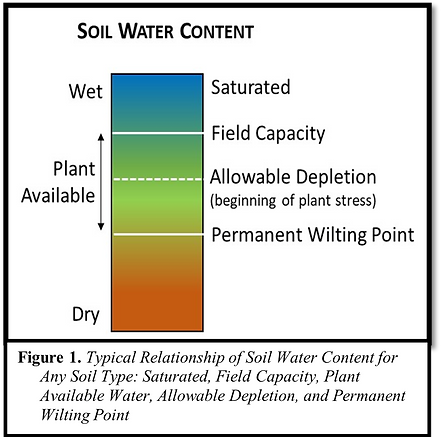
Soil water content includes both what is available and what is not available to the plant. Field Capacity (FC), Management or Maximum Allowable Depletion (MAD), and Permanent Wilting Point (PWC) make up a crop's water budget. The goal of irrigation scheduling and management is to use only the amount of water that the plant needs to thrive.
The soil texture plays a large role in irrigation management because of the way different soils behave with water. Clay soils hold the most water, sand the least, and silt is between sand and clay. Soils tend to have a combination of sand, silt, and clay in various percentages. Some of the most common topsoil textures within the lower Yakima Valley are silt loams, loams, and sandy loams.

Soil Moisture Monitoring

We can also provide soil moisture monitoring services. Soil moisture monitoring helps the grower determine water in the soil at various depths and help make informed decisions for irrigation scheduling. This can be accomplished using a soil moisture probe.
South Yakima CD offers Sentek Drill & Drop Bluetooth probes which are used to track moisture from irrigation and precipitation continuously throughout the growing season. The probes are 36 inches long, have nine sensors (one every 4 inches), and track real-time data that can be uploaded and viewed in the IrriMAX Live app.
Benefits include:
-
Free installation by South Yakima CD
-
Low-cost rental subscription at $120 per year (and sometimes free!)
-
Help identifying the right time to irrigate
-
Measure soil temperature
-
Conserve water during drought
-
Prevent over-irrigation or under-irrigation
The best time to install a probe is usually at the beginning of the growing season or irrigation season.